
Finding the right roofing contractor is one of the most important decisions a homeowner can make when a roof needs repair, maintenance, or replacement. Your roof protects the structure, interior, and belongings of your home from rain, wind, snow, heat, and other weather conditions. Poor-quality roofing work can lead to leaks, structural damage, premature roof failure, and expensive repairs.
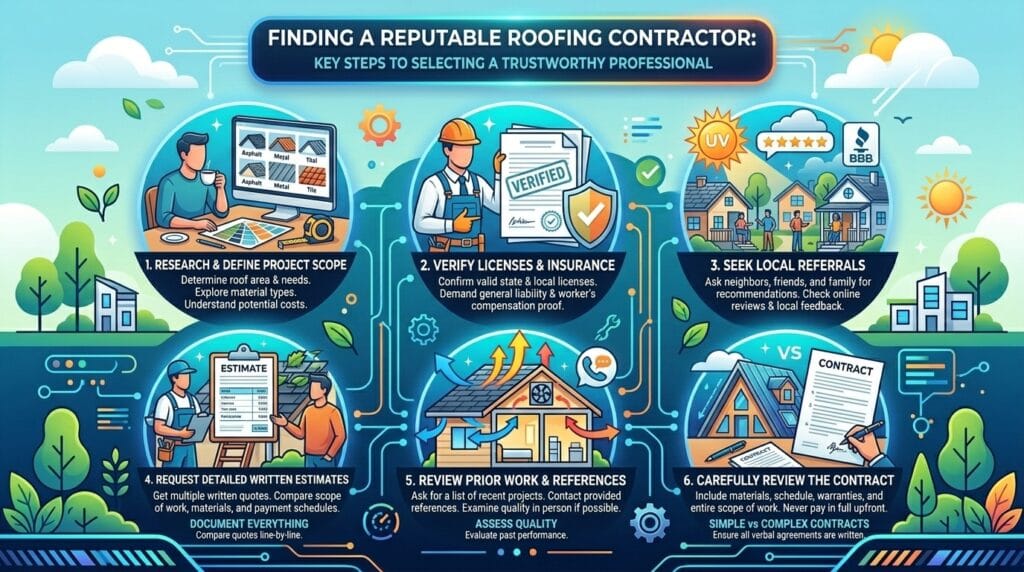
With many roofing companies competing for homeowners’ business, it can be difficult to know which contractor is trustworthy and qualified. The cheapest estimate is not always the best option, and a professional-looking website does not necessarily guarantee quality workmanship. Homeowners should evaluate a contractor’s experience, licensing, insurance, reputation, written estimates, warranties, communication, and overall professionalism before signing a contract.
The best approach is to research several local contractors, verify their credentials, compare detailed estimates, ask important questions, and make sure everything is documented in writing. Taking these steps can help you find a roofing contractor who is capable of completing the project properly and standing behind their work.
Why Is It Important to Choose the Right Roofing Contractor?
A roofing contractor has a major impact on the quality and lifespan of your roof. Even high-quality roofing materials can fail prematurely if they are installed incorrectly. Improper fastening, inadequate flashing, poor ventilation, incorrect underlayment installation, and other mistakes can create opportunities for water intrusion and roof damage.
Hiring the right contractor can also help you avoid unnecessary expenses. An experienced roofer should be able to identify existing problems, explain which repairs are necessary, and provide a realistic estimate for the project. A reputable contractor will also explain the materials being used, expected timeline, warranty coverage, and potential issues that could affect the final cost.
Choosing a qualified contractor is therefore about more than finding the lowest price. Homeowners should consider the overall value of the proposal, including workmanship, materials, warranties, experience, reputation, communication, and project management.
How to Find a Roofing Contractor Near You
There are several ways to find roofing contractors in your area. The goal is not simply to create a list of companies but to identify several qualified candidates that you can research and compare.
Ask Friends, Family, and Neighbors for Recommendations
One of the easiest ways to find potential roofing contractors is to ask people you know who have recently completed roofing work. Friends, family members, coworkers, and neighbors may be able to recommend contractors they have personally hired.
Ask them about more than just the final result. Find out whether the contractor arrived when promised, communicated clearly, kept the property clean, stayed close to the agreed budget, and handled unexpected problems professionally.
Personal recommendations can be useful because they are based on actual customer experiences. However, you should still verify the contractor’s credentials and obtain your own estimate before hiring them.
Search Online for Local Roofing Contractors
Online searches can help you identify roofing companies serving your area. Search for terms such as “roofing contractor near me,” “roof repair contractor,” “roof replacement company,” or “local roofing contractor.”
Google Maps and local search results can provide information about business locations, customer reviews, services, photographs, and contact information. You can also explore reputable directories and industry organizations.
When searching online, don’t automatically choose the company that appears first. Search several contractors and investigate their reputation, experience, credentials, and customer feedback.
Check the Contractor’s Website
A professional roofing company’s website can provide useful information about its services and experience. Look for clear information about the company’s service areas, roofing services, years in business, materials, warranties, and contact information.
Project photographs can also help you understand the types of roofing work the company performs. However, photos alone should not be considered proof of quality. A contractor should also be able to provide references and documentation supporting their qualifications.
Pay attention to whether the website provides a legitimate business address and clear contact information. Be cautious if it is difficult to determine who operates the company or where the business is located.
Check Online Reviews and Reputation
Online reviews can provide valuable insight into how a roofing company treats its customers. Look at reviews across multiple reputable platforms rather than relying on a single website.
Pay particular attention to comments about workmanship, communication, punctuality, pricing transparency, cleanup, and warranty service.
Don’t focus exclusively on the overall star rating. Read the actual reviews and look for patterns. A few negative reviews do not automatically mean a contractor is unreliable, while hundreds of generic positive reviews do not necessarily prove excellent workmanship.
What Should You Look for in a Roofing Contractor?
Once you have identified several potential contractors, evaluate each one based on important qualifications.
Local Experience
Experience working in your local area can be valuable because roofing contractors may be familiar with local weather conditions, common roofing materials, building requirements, and permitting processes.
A contractor who has completed many roofing projects in your area may also have references you can contact. However, local presence should not be the only qualification you consider. A contractor should still have appropriate licensing, insurance, experience, and a strong reputation.
Proper Licensing
Roofing license requirements vary depending on the state, county, or municipality. Some areas require specific contractor licenses, while others have different registration requirements.
Ask the contractor whether licensing is required in your location and, if applicable, request the relevant license information. You can then verify it through the appropriate government agency.
Insurance Coverage
A reputable roofing contractor should carry appropriate insurance coverage. General liability insurance can help protect against certain types of property damage, while workers’ compensation coverage may help address injuries involving employees.
Don’t simply assume that a contractor has valid insurance because they say they do. Ask for proof of current coverage and verify that the information is valid.
Roofing Certifications
Some roofing manufacturers offer contractor certification programs. These programs may require contractors to meet certain training, experience, or installation standards.
Manufacturer certifications can be useful when comparing contractors, particularly if you are purchasing a specific roofing product. However, certification should be considered alongside other factors such as experience, insurance, reviews, and references.
Strong Reputation
A good roofing contractor should have a history of satisfied customers and completed projects. Look for consistent positive feedback about the quality of work, communication, scheduling, and problem resolution.
You can also ask the contractor for references from recent projects that are similar to yours.
Written Contracts
Never rely entirely on a verbal agreement for a major roofing project. A professional contractor should provide a written contract that clearly explains the work to be performed, materials, cost, payment terms, warranty, timeline, and other important conditions.
A detailed contract protects both the homeowner and contractor by establishing clear expectations before work begins.
What Questions Should You Ask a Roofing Contractor?
Asking the right questions can help you determine whether a contractor is qualified and whether they are a good fit for your project.
How Long Have You Been in Business?
This question can help you understand the contractor’s experience and history. However, years in business should not be the only factor you consider.
Are You Licensed to Perform Roofing Work?
Ask whether a license is required in your location and request the appropriate license information if applicable.
Do You Carry General Liability Insurance?
Ask for proof of current insurance rather than relying solely on a verbal statement.
Do You Have Workers’ Compensation Coverage?
If the contractor has employees, ask about workers’ compensation coverage and verify the documentation where appropriate.
Can You Provide References?
A reputable contractor should generally be comfortable providing references from previous customers or examples of completed projects.
What Roofing Materials Do You Recommend?
Ask why the contractor recommends a particular roofing material. A good roofer should explain the advantages, limitations, expected lifespan, and maintenance requirements of the proposed material.
Who Will Perform the Work?
Find out whether the company’s own employees will complete the work or whether subcontractors will be involved.
Will You Use Subcontractors?
If subcontractors will be used, ask who they are and who will be responsible for supervising the project.
What Warranty Do You Provide?
Ask about the workmanship warranty and what happens if a problem occurs after the project is completed.
What Manufacturer Warranty Comes With the Materials?
Roofing materials may come with manufacturer warranties, but coverage can depend on the product and installation requirements. Ask the contractor to explain the applicable warranty.
How Long Will the Project Take?
Ask for an estimated start date and completion timeframe. Keep in mind that weather and unexpected structural repairs can affect the schedule.
How Will You Handle Unexpected Roof Damage?
Problems such as damaged roof decking may not be visible until old roofing materials are removed. Ask how additional work will be documented and approved.
How Will You Protect My Property?
A professional roofing contractor should have a plan for protecting landscaping, siding, windows, driveways, and other parts of the property during construction.
How Will You Handle Cleanup and Disposal?
Ask whether removing old roofing materials, nails, packaging, and construction debris is included in the project.
How Many Roofing Contractors Should You Contact?
Homeowners should generally consider obtaining estimates from at least three qualified roofing contractors when practical. Comparing multiple proposals can help you understand the typical scope and pricing for your project.
However, getting three estimates does not mean choosing the cheapest one. Contractors may propose different materials, installation methods, warranties, and levels of work.
For example, one estimate may include replacement of damaged decking while another may assume that the existing decking is usable. One contractor may include upgraded underlayment or flashing while another may use a basic option.
The best comparison is therefore between similar scopes of work, not simply between final prices.
How to Get a Roofing Estimate
A good roofing estimate should begin with a proper inspection of the roof.
Schedule an On-Site Roof Inspection
A contractor should evaluate the actual roof whenever possible. The inspection may include the shingles, flashing, valleys, roof penetrations, gutters, ventilation, and visible signs of structural or moisture damage.
For replacement projects, the contractor should also explain what may need to be inspected after the existing roofing material is removed.
Ask for a Detailed Written Estimate
A detailed estimate should clearly explain what you are paying for. Depending on the project, it may include:
- Roofing materials
- Labor
- Tear-off
- Disposal
- Underlayment
- Flashing
- Ventilation
- Drip edge
- Roof deck repairs
- Permits where applicable
- Cleanup
- Total project cost
The more detailed the estimate is, the easier it becomes to compare contractors.
Compare Estimates Carefully
If one contractor’s estimate is dramatically lower than the others, ask why. A low estimate may be legitimate, but it could also indicate that certain materials or services were excluded.
Ask each contractor to clarify differences before making a decision.
What Should Be Included in a Roofing Contract?
A roofing contract should provide enough detail that both parties understand exactly what will happen during the project.
Contractor Information
The contract should identify the roofing company and provide appropriate business and contact information.
Scope of Work
The scope should explain whether the project involves repair, partial replacement, or complete roof replacement.
Roofing Materials
The contract should identify important materials such as the shingle type, manufacturer, product line, color, underlayment, flashing, and ventilation products when applicable.
Project Cost
The total price and payment schedule should be clearly stated. Any conditions that could cause additional charges should also be explained.
Project Timeline
The contract should identify the anticipated start and completion timeframe, while recognizing that weather and unforeseen conditions can affect the schedule.
Warranty Information
The contract should explain the contractor’s workmanship warranty and the manufacturer’s material warranty.
Cleanup and Disposal
The agreement should clarify who will remove old roofing materials and construction debris from the property.
How to Compare Roofing Contractor Estimates
A simple comparison chart can make it easier to evaluate multiple proposals.
| Factor | Contractor A | Contractor B | Contractor C |
|---|---|---|---|
| Total Cost | |||
| Roofing Material | |||
| Tear-Off | |||
| Underlayment | |||
| Flashing | |||
| Ventilation | |||
| Warranty | |||
| Timeline | |||
| Insurance | |||
| Reviews |
Compare the actual scope of work rather than focusing only on the final price.
A contractor charging more may be including better materials, additional preparation, improved ventilation, more extensive flashing, or a stronger warranty. Understanding these differences can help you determine whether the additional cost provides meaningful value.
What Are the Red Flags of a Bad Roofing Contractor?
Knowing what to avoid is just as important as knowing what to look for.
Extremely Low Estimates
An unusually low estimate should raise questions. It could mean the contractor is using lower-quality materials, excluding important work, underestimating labor, or planning to add charges later.
Ask the contractor to explain exactly what is included.
No Written Contract
Avoid relying on verbal promises for a major roofing project. A written agreement protects both sides and establishes expectations.
Pressure to Sign Immediately
Be cautious if a contractor pressures you to sign a contract immediately or claims that an offer is available for only a few hours.
A reputable contractor should give you reasonable time to review the proposal.
Large Upfront Payment
Payment requirements vary by contractor and location, but homeowners should be cautious about unusually large upfront payments.
Make sure the payment schedule is clearly documented in the contract.
No Proof of Insurance
A contractor who refuses or fails to provide appropriate proof of insurance should be treated cautiously.
Unwillingness to Provide References
If a contractor refuses to provide any references or examples of previous work, consider asking why.
Poor Communication
Difficulty getting answers before the project begins can become an even bigger problem once construction starts.
Choose a contractor who responds clearly and professionally to your questions.
No Physical Business Information
Be cautious if you cannot determine where the company operates or how to contact it after the project is completed.
Door-to-Door Storm Chasers
After major storms, some contractors travel from one affected area to another looking for immediate business. This does not automatically mean a contractor is unqualified, but homeowners should perform additional due diligence before hiring them.
Requests for Cash-Only Payment
Be cautious of contractors who insist on cash-only transactions or refuse to provide proper documentation.
Changing the Price Without Explanation
Unexpected costs can occur when hidden damage is discovered, but legitimate additional work should be explained and documented.
How to Verify a Roofing Contractor’s Credentials
Before signing a contract, take time to verify the contractor’s qualifications.
Verify Licensing
Check applicable state or local licensing requirements and verify the contractor’s information through the appropriate authority.
Verify Insurance
Ask for current proof of insurance and make sure the coverage is appropriate for the work being performed.
Check Manufacturer Certifications
If the contractor claims to be certified by a roofing manufacturer, verify the certification when possible.
Check Business Registration
Confirm that the company is legitimately registered to operate in your area where applicable.
Check Complaints and Disciplinary Records
Government agencies and consumer organizations may provide information about complaints, licensing actions, or other issues.
Check References
Contact recent customers when possible and ask about their overall experience.
How to Check Roofing Contractor Reviews
Reviews can provide useful information, but they should be evaluated carefully.
Look for recurring comments about:
- Workmanship
- Communication
- Timeliness
- Cleanliness
- Pricing
- Warranty support
- Problem resolution
Don’t Focus Only on the Star Rating
A four-star company with hundreds of detailed reviews may provide more useful information than a five-star company with only a handful of reviews.
Read both positive and negative reviews to understand how the company handles different situations.
Look for Recent Reviews
Recent reviews are often more relevant because businesses can change ownership, management, employees, or operating practices over time.
Look for Similar Roofing Projects
If you need a complete roof replacement, reviews from customers who only hired the contractor for gutter cleaning may not tell you much about their roofing installation quality.
How to Choose Between Roofing Contractors
After researching several contractors, evaluate them using a consistent framework.
Consider:
- Credentials
- Insurance
- Experience
- Reputation
- Roofing materials
- Detailed estimate
- Warranty
- Communication
- Timeline
- Price
The contractor who offers the lowest price may not provide the best value. Instead, look for a company that combines competitive pricing with appropriate materials, professional installation, strong communication, and clear warranty coverage.
What Should You Expect During a Roof Inspection?
A professional roof inspection may involve examining multiple areas of the roofing system.
The contractor may inspect shingles, flashing, valleys, chimneys, skylights, vents, gutters, roof edges, and other visible components.
They may also look for evidence of leaks, storm damage, moisture intrusion, deteriorated materials, poor ventilation, or structural problems.
Ask the contractor to explain their findings clearly. Photographs can also be useful because they allow you to see problems that may be difficult to observe from the ground.
How to Find a Roofing Contractor After a Storm
Finding a contractor after a major storm requires additional caution because demand for roofing services can increase quickly.
Avoid Making a Quick Decision
Storm damage can create urgency, but homeowners should still research contractors before signing an agreement.
Verify the Contractor’s Local Presence
Confirm the company’s business information and determine whether it has an established presence in the community.
Check Insurance and Licensing
Verify applicable licensing and insurance before hiring anyone.
Get Multiple Estimates
Compare multiple contractors whenever practical.
Don’t Sign Under Pressure
Be cautious if a contractor claims that you must sign immediately.
Be Careful With Insurance Claims
Homeowners should understand their own insurance policy and should be cautious of contractors who make unrealistic promises about claim approval or guarantee that insurance will cover the entire project.
How Much Does It Cost to Hire a Roofing Contractor?
The cost of hiring a roofing contractor varies significantly depending on the project.
Important factors include:
- Roof size
- Roofing material
- Labor rates
- Roof pitch
- Roof complexity
- Geographic location
- Existing roof removal
- Roof deck condition
- Flashing
- Ventilation
- Disposal
- Permits
A small roof repair will have very different costs from a complete roof replacement.
Instead of relying on a general online price, homeowners should request a detailed estimate based on an actual inspection of their property.
How to Avoid Roofing Scams
Homeowners can reduce their risk of roofing scams by following a few basic precautions.
Always verify the contractor’s identity, licensing where applicable, insurance, business information, and reputation.
Get multiple estimates and make sure the scope of work is clearly written. Avoid paying the entire project cost upfront and be cautious about high-pressure sales tactics.
Never sign blank documents or agreements containing unclear terms. If the contractor proposes additional work after the project begins, make sure the changes and additional costs are documented.
Should You Hire a Local Roofing Contractor?
Hiring a local contractor can offer several potential advantages. A local roofer may understand the area’s weather conditions, common roofing materials, local building requirements, and permitting processes.
A local company may also have established relationships with suppliers and previous customers in the area. If a problem occurs after the project is completed, it may be easier to contact a contractor with an established local presence.
However, being local does not automatically mean a contractor is qualified. Homeowners should still verify licensing, insurance, experience, reputation, references, and warranties.
DIY Roofing vs. Hiring a Professional
Some basic roof maintenance tasks may be manageable for homeowners when performed safely, but major roofing work is generally best handled by qualified professionals.
Roofing involves working at heights, handling specialized materials, using appropriate tools, and following installation requirements. Mistakes can create leaks or damage that may not become obvious until months later.
Professional roofers also understand how to install flashing, underlayment, ventilation components, shingles, and other parts of the roofing system according to applicable requirements.
For significant repairs or roof replacement, hiring a qualified professional is usually the safer and more reliable approach.
When Should You Hire a Roofing Contractor?
You should consider contacting a roofing contractor when you notice signs of damage or when the roof is approaching the end of its expected service life.
Common reasons include:
- Roof leaks
- Missing shingles
- Storm damage
- Hail damage
- Sagging areas
- Widespread granule loss
- Curling shingles
- Damaged flashing
- Water stains
- Repeated repairs
- An aging roof
- Planned roof replacement
- Buying or selling a home
A professional inspection can help determine whether the problem requires a simple repair or a complete replacement.
Roofing Contractor Checklist
Before hiring a roofing contractor, use this checklist:
- Verify licensing where applicable
- Verify insurance
- Check online reviews
- Check references
- Confirm business information
- Get multiple estimates
- Compare roofing materials
- Compare warranties
- Get a written contract
- Confirm payment terms
- Confirm the project timeline
- Confirm cleanup and disposal
- Confirm who handles permits
- Ask about subcontractors
- Never sign under pressure
Frequently Asked Questions About Finding a Roofing Contractor
How do I find a good roofing contractor?
Start by asking for recommendations, searching for established local roofing companies, checking reviews, verifying credentials and insurance, and obtaining multiple detailed estimates.
How many roofing estimates should I get?
Getting at least three estimates from qualified contractors can help you compare pricing, materials, warranties, timelines, and scope of work.
What questions should I ask a roofing contractor?
Ask about experience, licensing, insurance, materials, warranties, references, subcontractors, project timeline, payment terms, cleanup, and how unexpected repairs will be handled.
How do I verify a roofing contractor?
Check applicable licensing, verify insurance, review the company’s reputation, confirm business information, check references, and verify manufacturer certifications when applicable.
Should I hire a local roofing contractor?
A local contractor may be familiar with local weather and building requirements and may be easier to contact after the project. However, local presence should be considered alongside experience, insurance, reputation, and credentials.
What should a roofing estimate include?
A detailed estimate should explain the materials, labor, tear-off, disposal, underlayment, flashing, ventilation, potential repairs, cleanup, and total cost.
What should be included in a roofing contract?
The contract should identify the contractor, scope of work, materials, total price, payment schedule, timeline, warranties, change-order process, and cleanup responsibilities.
How do I know if a roofing contractor is legitimate?
Verify the contractor’s business information, applicable licensing, insurance, reviews, references, and certifications. Be cautious of contractors who pressure you to sign immediately or refuse to provide documentation.
What are the biggest roofing contractor red flags?
Major red flags include extremely low estimates, no written contract, pressure to sign immediately, lack of insurance documentation, unusually large upfront payment demands, poor communication, and unexplained price changes.
Should I choose the cheapest roofing estimate?
Not necessarily. A low estimate may exclude important materials or services. Compare the complete scope of work, materials, warranties, experience, and reputation before making a decision.
How much should I pay a roofing contractor upfront?
Payment requirements vary by contractor and location. Homeowners should review the payment schedule carefully and be cautious about unusually large upfront payments or requests to pay the entire project cost before work begins.
Do roofing contractors need insurance?
Insurance requirements vary, but appropriate coverage is important for protecting homeowners and workers. Ask contractors for proof of current coverage.
What type of warranty should a roofing contractor provide?
Ask about both the contractor’s workmanship warranty and the roofing manufacturer’s material warranty. Understand what each warranty covers and what conditions may apply.
How long does a roof replacement take?
The timeline depends on roof size, complexity, weather, materials, crew size, tear-off requirements, and unexpected repairs. Your contractor should provide an estimated schedule before work begins.
Can a roofing contractor help with an insurance claim?
A contractor can document visible storm damage and provide an estimate, but homeowners should review their insurance policy and communicate directly with their insurance company. Be cautious of contractors who make unrealistic guarantees about claim approval.
What should I do if a roofing contractor does poor work?
Document the problems, review your contract and warranty, and contact the contractor in writing to request a resolution. If the issue cannot be resolved, homeowners may consider contacting the appropriate licensing authority, consumer protection agency, or legal professional depending on the circumstances.
Final Thoughts: How to Find the Right Roofing Contractor
Finding a reliable roofing contractor does not have to be difficult, but it should not be rushed. The best approach is to research, verify, compare, inspect, review the contract, and then hire.
Start by finding several potential contractors through recommendations and local searches. Check their reputation, experience, licensing where applicable, insurance, certifications, and references. Then obtain detailed written estimates and compare the actual scope of work rather than simply choosing the lowest price.
Before work begins, make sure the contract clearly explains the materials, cost, payment schedule, timeline, warranties, cleanup, and procedures for unexpected repairs.
A quality roofing contractor should be transparent, professional, properly qualified, and willing to answer your questions. Taking the time to choose carefully can help protect your investment and give you greater confidence that your roofing project will be completed correctly.
Our Construction & Remodeling Services in Houston, TX
Looking for professional construction, roofing, or remodeling services in Houston, Texas? Abbott & Crane provides a range of residential and commercial services designed to improve, protect, and add value to your property.
- Commercial Roofing Services – Professional roofing solutions for commercial properties throughout Houston.
- Home Remodeling & Additions – Expand and improve your Houston home with professional remodeling and addition services.
- Siding Replacement & Installation – Upgrade your home’s exterior with durable siding installation and replacement.
- New Construction – Complete construction solutions for new residential and commercial projects.
- Kitchen Remodeling – Create a more functional and attractive kitchen with professional remodeling services.
- Window Installation & Replacement – Improve your home’s comfort, appearance, and energy efficiency with new windows.
- Interior Remodeling – Transform interior spaces with customized remodeling solutions.
- Bathroom Remodeling – Upgrade your bathroom with professional design and remodeling services.